
Most fraud doesn’t need a clever scheme; it just needs an opening. The Christmas holiday period creates several openings at once: key people are on leave; others are covering roles they don’t usually do; suppliers want to be paid before close-down; and everyone is tired and keen to get out the door.
The controls your organisation relies on were designed for a normal week, with the right people in the right seats. Over the break, these conditions can quietly fall away.
Controls don’t disappear. The people who run them do.
Over the break, your policies stay the same on paper. What changes is who is operating them, and whether anyone is checking. Three patterns are worth watching.
Approving and paying fall on one person.
With the usual approver away, the person processing payments also approves them “just this once”. Segregation of duties still exists in the policy, but it isn’t happening.
Access expands and nobody pulls it back.
Colleagues or temporary staff covering a role are given system access to keep things moving. Unless someone owns removing it, that access can linger.
Urgency overrides process.
The rush to get things paid before the break is exactly the sort of pressure a fraudster will exploit. A late request to change a supplier’s bank details is more likely to slip through when everyone is rushing, or the person who would normally question it is on leave.
What the data tells us
These patterns aren’t hypothetical. The latest global data is clear about where fraud starts. The Association of Certified Fraud Examiners’ (ACFE) Occupational Fraud 2026: A Report to the Nations found that the most common internal control weaknesses were a lack of internal controls, management override of existing controls, and a lack of management review. These three weaknesses accounted for 70% of cases in the study.
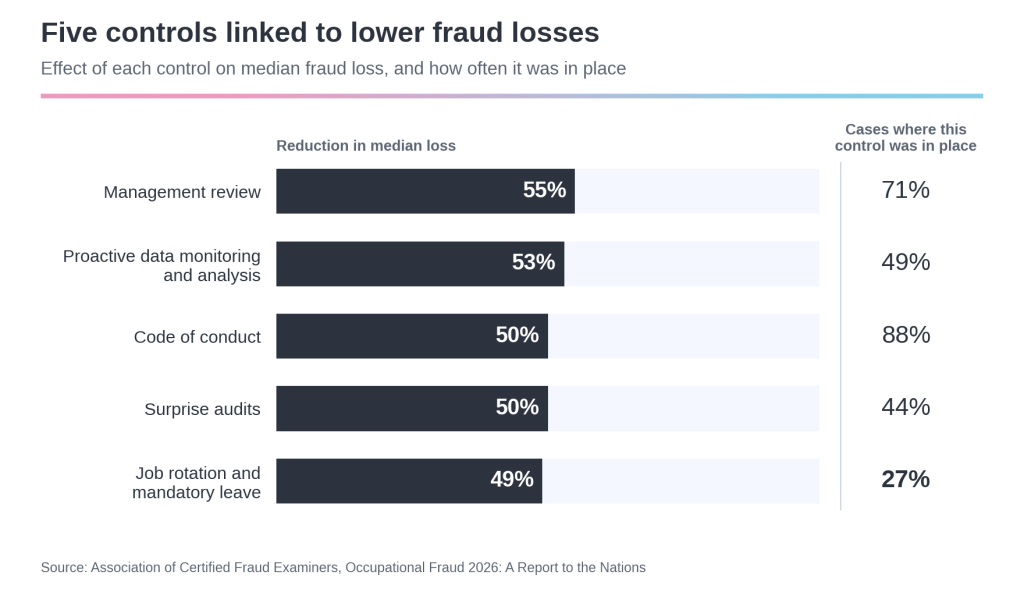
Conversely, five controls were found to be the most effective in reducing losses from fraud: management review, proactive data monitoring and analysis, a code of conduct, surprise audits, and job rotation and mandatory leave.
The break can also bring fraud to light
One of the behavioural red flags the ACFE tracks is a refusal to take leave.
Someone who never takes a break, and never lets anyone else near their work, may simply be dedicated. Or they may be protecting something. When another person steps into the role, irregularities have a way of surfacing. It helps explain why job rotation and mandatory leave rank among the most effective controls. Yet they were in place in only 27% of cases in the ACFE study.
You can use the break as a live test of your controls. Ask people covering roles to flag anything that doesn’t look right (and make it easy for them to do so). Even where nothing is wrong, fresh eyes often spot gaps that could be exploited, or steps that could simply work better.
Seven governance questions to ask before close-down
Whoever oversees your organisation, whether that’s the owner, CEO, Board or Audit Committee, should expect clear answers to these questions before the break.
1. Who approves what, and who is their backup?
Confirm delegations and spending limits for the period (in writing), including who steps in if the delegate can’t be reached.
2. Is segregation of duties still intact?
Where it can’t be, what is the compensating control?
A second approver from senior leadership or the Board, or dual authorisation in your banking platform, keeps the check in place.
3. What temporary access is being granted and when does it end?
Set the end date when access is granted, and have someone confirm when it has been removed.
4. How are changes to supplier bank details verified?
Your standard policy should require a call-back to a number already on file or from an independent source such as the supplier’s official website, never one supplied in the request. Reinforce the policy with anyone performing these roles over the break.
5. What gets reviewed when people return?
Payments made, new suppliers, changes to supplier details and manual journals over the period should be reviewed by someone who wasn’t involved.
6. How will you spot what doesn’t look right?
If your systems allow it, run an exception report. For example, look for payments outside normal patterns, or payments approved by the person who processed them. Keep the timing or scope of the check unannounced. A review people can’t predict is a stronger deterrent.
7. Do people know what to look out for and how to raise a concern?
Tip-offs are the most common way fraud is found: 43% of cases in the ACFE data, nearly three times the next most common method. That only works if your team, including temporary staff, know the warning signs and how to report them. Before the break, circulate a short reminder of your code of conduct, along with details of how to report concerns.
Keep it simple
The break is a predictable pressure point that comes around every year. That makes it one of the easiest fraud risks to plan for. A short conversation before close-down about who approves, who checks and what gets reviewed on return costs very little. An investigation in February costs a great deal more – in money, time and trust.
Take the next step
Synectic’s internal audit and risk specialists can help you test whether your controls work in practice, not just on paper.
Contact our team and we’ll work through the seven questions with you before the break.